
Light and shadow: Which Enneagram type describes your hidden motivations?
(Global Heart) Have you ever wondered why you keep falling into the same traps? Or why your colleague interprets criticism so differently than you do? Sometimes it feels as if we all speak a different language when it comes to emotions and motivations. Fortunately, there is a fascinating tool that offers more clarity: the Enneagram.
How understanding the nine personality types of the Enneagram can transform your life
The Enneagram is a powerful model of the human psyche that is widely used in therapy, business, and self-development circles. Its name comes from the Greek words ennéa (nine) and grámma (something written), referring to the nine archetypes that describe our personality.
How does the enneagram work?
At its core, the Enneagram is more than just a personality test; it is a system of transformation. While it was first conceptualised by the mystic Gurdjieff and later developed by figures like Oscar Ichazo and Claudio Naranjo, its goal remains the same: to help us understand our “blind spots” and liberate the soul underneath.
By identifying your type, you gain insight into:
- Your deepest desires and what you value most.
- The things that tempt you or cause you the most fear.
- Your greatest faults, but also your most powerful virtues.
It is a highly psycho-spiritual model, meaning it bridges the gap between our psychology and our spiritual journey. It helps us see where our ego might have lost touch with a deeper sense of reality, helping us return to a state of higher awareness.
How to find your enneagram type
Finding your type is a journey of self-observation rather than a quick label. While online tests are a great starting point, the most reliable way to identify your type is through honest reflection.
As you read the descriptions below, pay attention to your internal reaction. We often feel a slight ‘trigger’ or a sense of discomfort when we encounter the type that describes our shadow sides best. Ask yourself: “Does this describe my deepest motivation, even the parts I usually hide from others?” Remember, your type is defined by why you do what you do, not just your outward behaviour.
Which Enneatype are you?
It is common to see a little bit of yourself in all nine types, but usually, one or two will stand out as your dominant personality.
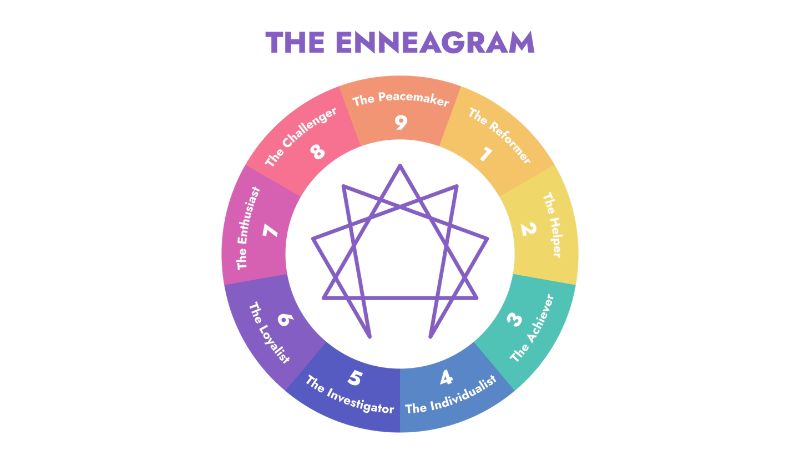
The nine Enneagram types include:
- Type 1 – The reformer
- Type 2 – The giver
- Type 3 – The performer
- Type 4 – The individualist
- Type 5 – The observer
- Type 6 – The loyalist
- Type 7 – The idealist
- Type 8 – The challenger
- Type 9 – The peacemaker
Here is an overview of the nine archetypes:
Type 1: The reformer (The perfectionist)
Ones are motivated by a strong sense of right and wrong. They are the “crusaders” of the Enneagram, always striving to improve things and avoid mistakes. While they are incredibly reliable and principled, they often struggle with a loud inner critic that tells them they—and others—are never quite good enough.
Their shadow side manifests as a very self-demanding and self-critical personality; they unconsciously create an unattainable ideal of how they should be. This often leads to suppressed anger and irritation when reality falls short of their standards.
- The growth path: Learning to transform their inherent anger and frustration into patience and accepting that there is beauty in imperfection.
Type 2: The giver (The helper)
Twos are heart-centered individuals who want to be loved and needed. They are incredibly intuitive when it comes to the needs of others and will go out of their way to be supportive.
Their shadow side is rooted in the belief that loving oneself is selfish, leading them to prioritize everyone else’s needs over their own. Hoping that their selflessness will be rewarded with affection. This can result in a prideful “savior” complex where they give advice constantly, only to later feel resentful if their help isn’t acknowledged.
- The growth path: Shifting from seeking validation through helping others to practicing self-care and finding true humility.
Type 3: The performer (The achiever)
Threes are energetic, ambitious, and highly focused on goals. They are the “stars” who want to be successful and admired. Because they are so good at adapting their image to what others value, they can lose touch with their own authentic feelings and desires.
Their shadow side involves a deep-seated fear of being worthless, which they mask with professional triumphs and a polished personal image. Because they value the approval of others above all else, they often hide behind a competitive mask and lose touch with their true identity.
- The growth path: Moving away from a focus on professional triumphs and external validation toward authenticity and self-worth.
Type 4: The individualist (The romantic)
Fours seek to be unique and special, drawn to creativity and depth. They often feel that they are missing something that others possess.
Their shadow side is characterized by self-centeredness and a tendency to get lost in emotional storms of envy, sadness, and melancholy. They often feel misunderstood and go through intense highs and lows while comparing themselves to others.
- The growth path: Learning to focus less on internal emotional storms and more on contributing their unique gifts to the world.
Type 5: The observer (The investigator)
Fives are the most analytical and private type. They fear being overwhelmed by the world, so they retreat into their minds to gather knowledge and feel competent.
Their shadow side manifests as emotional distance and a fear of physical or emotional contact. They often retreat into a cold, theoretical world to feel secure, avoiding action and social interaction.
- The growth path: Stepping out of the theoretical world and re-connecting with their heart and body to find a balance between thinking and feeling.
Type 6: The loyalist
Sixes are the most safety-oriented type. They are excellent at troubleshooting and anticipating what could go wrong. Because they lack inner certainty, they often look for external structures or people to trust. They oscillate between being very cautious and being surprisingly rebellious.
Their shadow side keeps them in a state of constant alertness and chronic worry about the future. They often struggle to make decisions and look to external authorities or rules to quiet their inner anxiety.
- The growth path: Transforming their anxiety and cowardice into courage by learning to trust their own inner guidance.
Type 7: The idealist (The enthusiast)
Sevens are the fun-loving optimists who want to experience everything life has to offer. They are quick thinkers and love new ideas.
Their shadow side involves a desperate need to avoid inner pain or boredom, leading to hyperactivity and impulsiveness. They are constantly seeking pleasure to distract themselves from uncomfortable feelings, which makes it hard for them to stay present.
- The growth path: Cultivating silence and the art of “being” rather than “doing,” allowing them to find true contentment within.
Type 8: The challenger
Eights are natural leaders who value strength and independence. They are protective and direct, but they fear being controlled.
Their shadow side is born from a fear of being hurt, leading them to construct a defensive wall. They often adopt an “offense is the best defense” strategy, becoming aggressive or overbearing when they feel threatened in order to maintain control.
- The growth path: Accepting their own vulnerability and realizing that true strength lies in being able to let their guard down.
Type 9: The peacemaker
Nines are the most easy-going and stable type. They want everything to be harmonious and will go to great lengths to avoid conflict.
Their shadow side is a tendency to go unnoticed and avoid conflict at any cost. Because they fear angering others, they often suppress their own opinions and desires, leading to a kind of laziness or lack of motivation to keep the peace.
- The growth path: Shifting from passivity to proactivity by asserting themselves and recognizing that their presence and voice are valuable.
Understanding your Enneagram wings
While your core type defines your primary engine, your Enneagram wings are what help you fly. In nature, everything exists in gradients—think of the shifting colors of a sunrise. We are no different. Your wings are the two types directly adjacent to your core type on the Enneagram star.
Knowing your wing is just as important as knowing your dominant type because it adds “humanity” and depth to your profile. It explains our contradictions and the “chiaroscuro” features of our soul.
For instance:
Enneagram 1w9: This blend combines the principles of the Reformer (Type 1) with the calm objectivity of the Peacemaker (Type 9). This allows them to see the “bigger picture” and helps ease their naturally self-demanding nature.
Enneagram 1w2: This blend mixes the Reformer’s ideals with the Helper’s (Type 2) warmth, making them more outward-looking and compassionate in their quest for improvement.
Why wings matter
- Precision: They refine your personality profile, making the Enneagram a more assertive tool for self-discovery.
- Adaptability: Once you internalize your wings, you can learn to “borrow” their positive attributes when you need them for your emotional health.
- Dynamics: Just like riding a bicycle, life requires movement. While you usually have one dominant wing (like being right-handed), life’s challenges may eventually wake up your second wing, providing you with new tools to handle the environment.
Enneagram and personal growth
The true power of the Enneagram lies in its ability to lead us toward a higher state of awareness. By helping us understand the roots of our fixations, we learn how our ego structure was formed and where it may have drifted away from a deeper, divine consciousness. Understanding your type is therefore not just a psychological exercise but a vital step in deepening your spiritual awakening.
Ultimately, this journey is about more than just self-improvement; it is about finding freedom from rigid personality patterns. By deconstructing the ego, we allow our true essence to emerge, paving the way for a more authentic and enlightened way of living.
Source: Global Heart
You may also like:
The three personality types of Ayurveda
A Journey into the Higher Self: Chris H. Hardy on the Transdimensional Mind