
Shake off bad vibes: stop strangers’ rudeness from ruining your day
(Global Heart) Unexpected rudeness can be jarring. Discover techniques to de-escalate confrontations, utilize deep breathing to calm your fight-or-flight response, and learn how to stop taking negativity personally.
How to shake off bad vibes from rude strangers
We’ve all been there: a fleeting interaction with a stranger—a sharp comment, an aggressive driver, or an overblown reaction to a minor mistake—leaves us rattled and tense. These moments, even though minor, can sting more deeply than expected. Why do these exchanges affect us so profoundly, and how can we effectively “shake off” the negative energy to regain control of our day?
Dealing with unpleasant interactions
The modern world’s rising levels of stress and anxiety often contribute to the increase in unpleasant public interactions. As psychiatrist Dr. Gail Saltz notes, when people are under duress, their capacity to handle social situations gracefully diminishes, leading to more explosive or rude reactions.
Why does an aggressive comment from someone we’ll never see again cause such emotional turbulence? It’s because these situations are often unforeseen and violate our expectations of civil social conduct. The jolt triggers a mix of confusion, anger, and distress, disrupting our emotional equilibrium. Understanding this natural reaction is the first step toward effective management.
How to calm down after a confrontation
The key to overcoming these moments lies in a three-part strategy: creating physical and emotional distance, calming the body’s stress response, and reframing the event.
Steps to regain control and find calm:
1. Immediate de-escalation techniques
These strategies are crucial when you are still physically near the person. The goal is to safely disengage and prevent the situation from worsening.
- Create physical distance: This is the most important step for safety. If at all possible, immediately and safely remove yourself from the area. Dr. Saltz emphasizes that trying to engage with or reason with an already agitated person rarely helps and can potentially escalate the situation further.
- Practice the “emotional exit”: If physical retreat isn’t an option (like being stuck in traffic or a crowded elevator), you must emotionally disengage. Turn your body slightly away, avoid direct eye contact, and maintain a neutral facial expression. This non-reactive posture signals that you are not engaging in the conflict.
- Use minimal, neutral language: If you are forced to respond, keep it brief and non-confrontational. Use simple phrases like; “My mistake,” or “I need to go now.”
2. The mind-body reset
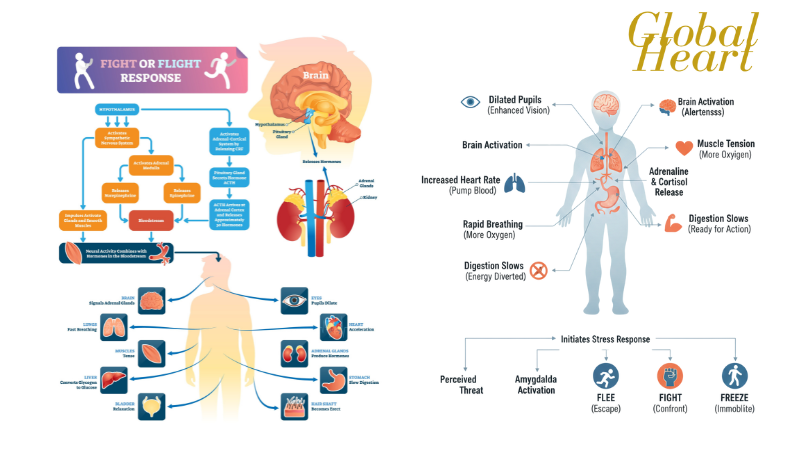
Once you are safe and away from the confrontation, your body is still in a heightened “fight-or-flight” state. These techniques help you consciously relax your nervous system.
A. Deep diaphragmatic breathing
This is a powerful tool to lower your heart rate and reset your nervous system.
- Inhale: Breathe in slowly through your nose for a count of 4. Focus on expanding your belly.
- Exhale: Purse your lips and exhale slowly through your mouth for a count of 6 or 7. The longer exhale is key to calming your nervous system.
- Repeat: Do this cycle 5 to 10 times until you feel your pulse slow down.
B. Progressive muscle relaxation (PMR)
Stress causes us to unconsciously clench muscles. PMR helps release that pent-up tension.
- Action: Consciously tighten a muscle group (like your fists or shoulders), hold for 5 seconds, and then fully release the tension.
- Focus: Pay attention to the contrast between the strained, tight feeling and the warmth of the relaxed state.
C. Physical release (post-incident)
As clinical psychologist Dr. Jody Thomas suggests, you need a physical release to complete a stress cycle.
- Action: Take a brisk 5-10 minute walk, do some quick stretches, or engage in any activity that uses your major muscle groups. This movement helps burn off residual stress chemicals and prevents the negative energy from lingering in your body and mind.
3. Validate your feelings, then let it go
It’s common to feel a range of emotions—anger, embarrassment, or even self-doubt—after such an encounter.
- Acknowledge the emotion: Do not invalidate your feelings by thinking, “I’m being silly.” Dr. Thomas stresses the importance of acknowledging that your reaction was a normal human response to an unexpected and unpleasant circumstance.
- Seek affirmation: If you’re struggling to let go, talking through the incident with a trusted friend or family member can be very therapeutic. Their affirmation helps you process the experience and move past it more quickly.
Shift in perspective: It’s not about you
The final, and most crucial, step in shaking off bad vibes is to depersonalize the event.
- Their day, not yours: Interactions with strangers are inherently superficial. They know nothing about you. As Dr. Saltz explains, the rudeness is overwhelmingly a reflection of their own inner distress, bad day, or personal issues, not anything you did. Adopting this viewpoint makes it much easier to detach from the interaction and prevent it from “spoiling your day.”
- Recognizing rumination: If you find yourself consistently ruminating (mentally chewing over the event) for weeks afterward, it may be a sign of deeper underlying anxiety or stress. In these cases, speaking with a mental health professional can provide strategies to manage these emotional patterns more effectively.
Rude encounters are an unfortunate reality, but by prioritizing distance, calming your physiological response, and remembering that their anger belongs to them, you can handle these situations with grace and protect your well-deserved peace of mind.
Take the next step: deepen your resilience
If you’re ready to move beyond quick fixes and build lasting resilience against stress and negative energy, explore these recommended books that offer deeper insights and practical tools:
-
For understanding your stress response:
-
Waking the Tiger: Healing Trauma by Peter A. Levine. Learn the psychological and physical basis of the fight-or-flight response and how to fully process lingering stress from jarring encounters.
-
-
For setting healthy emotional boundaries:
-
Boundaries: Where You End and I Begin by Anne Katherine. Master the essential skill of drawing lines between yourself and others. This book helps you truly embody the perspective: “It’s not about you, it’s about them.”
-
-
For conquering rumination and negative thoughts:
-
Feeling Good: The New Mood Therapy by David D. Burns, M.D. This classic guide to Cognitive Behavioral Therapy (CBT) gives you practical, powerful exercises to challenge and stop the cycle of ruminating over past interactions.
-
-
For integrating mindfulness:
-
Wherever You Go, There You Are: Mindfulness Meditation in Everyday Life by Jon Kabat-Zinn. Learn how to use simple mindfulness techniques (like your deep breathing exercise) to stay centered and non-reactive in any stressful situation.
-
Remember, you cannot control a stranger’s behavior, but you always control your reaction; choosing peace is the most powerful way to shake off their bad vibes for good.
Source: Global Heart
You may also like: