
The call to the far shore – How to care for the dying
(Global Heart | Nancy MacMillan) Having become disconnected from the natural cycles of life, we have lost the fundamental knowing of what death looks like, and fear fills the void. Learn more about how to transform our fears surrounding death and be with the dying more fully and more consciously. Discover how to care for the dying for their healing, ours, and the world’s.
Suffering, the Buddha said, if it does not diminish love,
will transport you to the farther shore.Huston Smith, Tales of Wonder
Scenes from frontline health care
Anyone who has experienced the passing of someone close
knows that death is a portal to love.
Charles Eisenstein, “The Coronation”
In my work in an acute care hospital, I was with a lot of people in the last stages of dying and at the time immediately following death—supporting the very ill and their families, providing advocacy, and being with the fierce emotional winds, the grasping for meaning and the shedding of old selves, that come with the terrain of dying. We used to be called multifaith chaplains; now the more apt, though admittedly more ambiguous term registered spiritual care practitioner is most often used. We are required to undergo intensive training and certification, and most of us are registered psychotherapists. Belonging to an organized religion is not an expectation, nor is it for a patient in requesting a visit or for a referral to be made. In fact, during my first encounters with an individual or family, especially in the midst of a crisis, I sensitively try to ascertain whether the person is religious (what kind and whether devoted or lapsed), spiritual (nature-based, pagan, angels, eclectic, unsure), humanist (kindness, fairness, realism, philosophical), or committed atheist. This knowledge helps me lean into the language most familiar to them to meet their psyche and soul needs, crucial to offering sensitive care at pivotal times.
When a person says, “I’m not religious,” it often means, “I want to relate to you authentically, not through a prescriptive lens of religious language.” When people do want to be met through their religious beliefs, they may be struggling to reconcile their faith with their situation: Why would God do this to me? Am I being punished? Is it cruel or a sin to take my husband off life support? My task is to be present to where a person is in their theology and listen to their hard questions of God. Easy answers are not wanted and not needed. Sometimes, it’s possible to support people in evolving their images of God, helping them let go of limiting notions that don’t serve them anymore—especially around an image of a distant God who punishes. Most of all, patients surprise me with a great pluralism and a healthy resistance to labeling.
The art of listening
For a patient with a life-threatening diagnosis, having someone to speak with is important medicine. Yet few are comfortable in this role! Just about everyone dances around the central concerns of a dying person. I remember being asked to mentor a resident doctor, Brent, on the art of listening. He was soon graduating with a specialty in palliative care, but his supervisor felt he had some ground to cover on bedside etiquette. Brent accompanied me on my rounds one day, and at last I asked him to take over the conversation with a female patient who had recently been told her prognosis was worsening and that she should “get her affairs in order.” After introductions, I left them alone. Brent came and found me about forty-five minutes later, his eyes on fire. He was thrilled at what had transpired: freed from his doctor agenda, he had realized his role was to empathetically listen to her struggles, fears, and concerns. He witnessed that through her being able to speak without restraint she turned a corner, in the end reassuring him that “she knows what she has to do now.” Brent said in astonishment, “Just listening was the hardest thing I’ve ever done and totally exhausting. I don’t know how you do this all day!” That was certainly validating to hear—yes, focused listening requires inner stillness involving our whole being. We are then in a relational field with the other person where so much more is present than the words being spoken.
While for me listening is relatively easy, what’s harder is something else. Going into the family room of the ER, intensive care unit, or cardiac unit, after someone has died—the room often filled with the accident victim’s family or the unsuccessful surgery patient’s family—being present as the worst news is delivered, and not knowing what to do.
How to be a comfort to someone
Our first instinct as human beings is to “make things better.” When nothing we do will change the radical outcome that has just happened, the impulse to fix or rescue must be held in check. Eventually, I learned that this adrenaline-fueled impulse is counterproductive: doing is not called for at this moment but being with is. Even then, I thought it my job to know how to do this well, to offer the right words, to find the right degree of involvement without becoming enmeshed. But inwardly I usually felt uncomfortable, stiff, reduced to platitudes, and in the way.
I remember one night when I was on call in my early training. The pager went off at 4 a.m. It was the cardiac unit calling for support. Chad, a young man of thirty-four, a family doctor himself, was suddenly dead from a cardiac arrest. His wife, Helen, wanted to talk to me. I arrived to a hushed room crowded with family members and friends. Helen, clearly in shock, holding herself stoically together, took me aside. Her one burning question: “Should I bring my four-year-old daughter in to see her father’s body?”
What children need
I spoke with her about their child, Katie, and heard of her easygoing nature and adoration of her daddy. I told her that children are less afraid of what they can see than what their imaginations may fill in, that her daughter’s presence here would make her part of a pivotal marker in their life as a family, and that, whenever possible, it’s a gift to let children be familiar with death. I said, “Children need simple, direct truthfulness. But,” I went on, “the most important question is: How comfortable are you? Your daughter will take her cues from you and the others around.” Helen went home to get Katie.
A little while later, Katie was holding tight to her stuffed dog on the bed next to Chad’s body, the mood in the room shifting. Grandparents were holding her and lovingly talking to her about why her dad looked asleep and that it was more than sleep: he had left his body, he had died.
Although children will express distress, confusion, and need by regressing in their behavior—maybe bed-wetting, thumb-sucking, withdrawing, clinging, or worrying that they or their other parent will also die—the consistent, warm response of close caregivers makes all the difference. Tears, trembling, and shaking are ways our bodies naturally come out of shock. Allowing this to unfold and be validated with reassuring words and gentle touch, while resisting the urge to talk someone out of their feelings, is the best thing we can offer. Children best express themselves through play and art, and when this is combined with consistent routine and boundaries, then a safe container is made to help a child rework their experience. It helps when we know children grieve in spurts and that innately they have the instinct to transform it as they mature, over time.
Other than the conversation affirming that it was good to include four-year-old Katie in this charged moment, I did very little. I stayed in the background, a quiet presence. Sometimes, it’s hard to know when to leave and how to leave a room and a family amid such a magnitude of loss. At last, I told them that I would be in the family room down the corridor if anyone wanted to speak with me privately. After a period of time, Helen came to find me. She, who had seemed so intact and not wanting to let anyone get too close, said, “Thank you, you were just so helpful to us all,” and broke down crying. In my head, I had been fighting the thoughts of being an intruder, a voyeur, an imposter, but with this last interaction I was left wondering about the greater truth that can lie in a receptive, quiet presence.
Morgue viewings
Another hard part of the work of a spiritual care practitioner: morgue viewings.
Being around dead bodies is unfamiliar to most of us. People shiver at the thought. “How can you possibly be around dead people every day?” people would exclaim to me. Over time, I have lost much of this aversion. But not entirely. There is always a trembling at the doorway when meeting someone recently dead, for there is so much that is still present, yet unfathomable, and it’s hard to keep any sense of “usualness.” Hospital staff will go out of their way to keep a person who has just died in their bed until family can arrive; however, there may be patients waiting for a bed in hallways or crowded ward rooms, or family members may be hours away. When this happens, the body is taken to the morgue where visitations can be arranged before the funeral transportation arrives.
***
The Call to the Far Shore by Nancy MacMillan published by Inner Traditions International and Bear & Company, © 2025. All rights reserved. http://www.Innertraditions.com Reprinted with permission of publisher.
***
How to care for the dying for their healing, ours, and the world’s
• Explores how to carry our loved ones through death, how to honor their bodies and spirits, and how to awaken to the ever-present help of our ancestors
• Reveals the healing and closure that can be brought about through the process of washing and preparing a body for a home vigil or funeral
• Offers guidance on advance care planning, grieving, and forgiveness as well as green burial
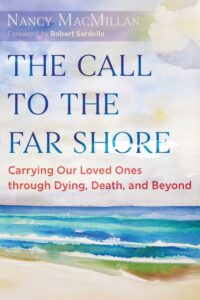 Having become disconnected from the natural cycles of life, we have lost the fundamental knowing of what death looks like, and fear fills the void. How can we transform our fears surrounding death and be with the dying more fully and more consciously?
Through her work with the dying, Nancy MacMillan reveals the very real imaginal world where nature, myth, dreams, ancestors, and those yet to be born whisper from the far shore, a place beyond our last breath. She reminds us that caring for our dying consciously is a transformative act, radical even, in restoring meaning to our place and purpose in the universe. She explores how to carry our loved ones through death, how to honor their bodies and spirits, and how to awaken to the ever-present help of our ancestors. She shows how the practice of caring for the dead can help both those grieving and the newly dead, and she reveals how healing and closure can be brought about through the process of washing and preparing a body for a home vigil or funeral—a ritual she provided for her own mother.
Sharing personal stories, Nancy offers guidance on advance care planning, grieving, and forgiveness as well as green burial. Through her own close encounters with the specter of death, the author shows how to follow the ancient wisdom of “learning to die before you die” and find a seaworthy passage to the far shore.
For more information or to purchase YOUR copy of “The Call to the Far Shore –
Carrying Our Loved Ones through Dying, Death, and Beyond” by Nancy Macmillan, click the book cover or visit Bol.
About the author
Nancy MacMillan is a registered psychotherapist and retired certified spiritual care practitioner with master’s degrees in education and theology and experience working in palliative care, intensive care, geriatrics, and bereavement. She lives outside of Kingston, Ontario.
Source: Global Heart
You may also like:
Your heart knows how to heal you
Rosemerry Wahtola Trommer: Love continues to grow even after loss