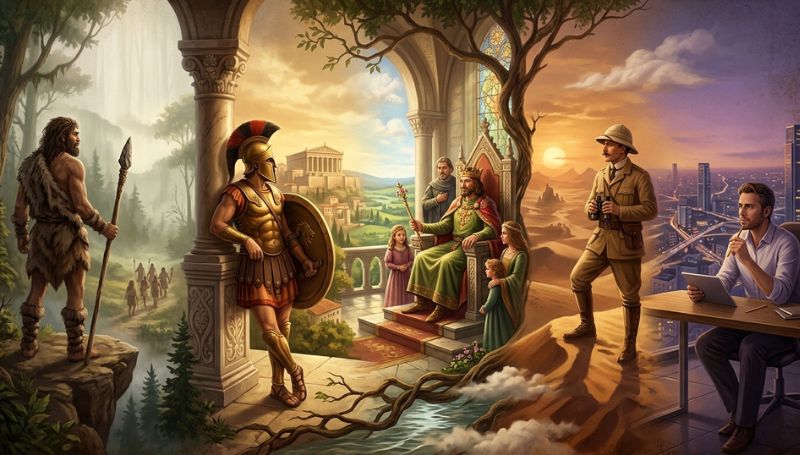
Reimagining the divine masculine: Beyond the “tough guy” stereotype
(Global Heart) In a world that is constantly evolving, our understanding of gender roles is shifting too. While many of us have spent time exploring the divine feminine—diving into the myths of goddesses, queens, and healers—the divine masculine often gets a bit less “screen time” in modern spiritual circles.
Exploring the many faces of masculinity
But masculinity isn’t a monolith. It’s not just about being the strongest person in the room or the one with the biggest bank account. Archetypes—those universal patterns or “original blueprints” of human personality—show us that there are countless ways to be a man. Whether you’re a man looking to connect with a deeper version of yourself or simply curious about the masculine energies in the world around you, looking at these archetypes can be a total game-changer.
What exactly is an archetype?
Think of an archetype as a mental prototype. The famous psychologist Carl Jung believed these are part of our “collective unconscious”—ideals we all recognize instinctively, regardless of where we grew up.
In the 1990s, authors Robert Moore and Douglas Gillette famously narrowed the male experience down to four main pillars: the King, the Warrior, the Magician, and the Lover. But as our culture changes, these roles expand and transform.

The twelve masculine archetypes
While the ‘Big four’ provide the foundation, modern masculinity expresses itself through an even wider spectrum. Let’s explore twelve specific archetypes that act as soul maps, that describes how a man interacts with the world, processes pain, and achieves maturity.
However, an archetype is only “divine” when it is in balance. Every powerful trait has a shadow—a version of that energy that emerges when we are disconnected from our heart or our purpose. What is often labeled as “toxic” is frequently just an archetype that has lost its equilibrium.
1. The Caregiver:
The essence: The Caregiver is the quiet force maintaining the emotional and physical stability of a home or community. He acts as the invisible glue of society. Driven by a deep-seated empathy, he serves not out of obligation, but because his heart simply cannot look away from suffering.
The lesson: He must learn that self-care is not selfishness. His true growth occurs when he discovers that he can only sustainably care for others if he acknowledges his own needs. Without boundaries, his devotion turns into depletion.
The shadow: Out of balance, he becomes the Martyr. He uses his sacrifices as emotional leverage (“look at all I’ve done for you”) or erases himself so completely that he becomes a “doormat” without an identity.
2. The Jester
The essence: The Jester uses humor as a bridge to connect people and a shield to diffuse tension. He possesses the unique gift of naming the “elephant in the room” in a way that doesn’t attack, but liberates.
The lesson: Maturity for the Jester means taking off the mask. He learns that humor is only truly powerful when it isn’t used to laugh away pain, but to create space for genuine joy and healing.
The shadow: The Trickster. This side uses wit to avoid depth or to subtly belittle others. He makes a joke of everything to escape his own insecurities and the confrontation with reality.
3. The Rebel
The essence: The Rebel is defined by a fierce independence and an allergy to injustice. He is the one who dares to break with traditions that no longer serve. He doesn’t kick at “sacred cows” for the thrill, but to make room for the truth.
The lesson: He must learn to transform his anger from a destructive force into a compass. True rebellion isn’t just about tearing something down; it’s about taking responsibility for building something better.
The shadow: The Anarchist. In this state, he destroys purely out of bitterness. He burns bridges and relationships without a vision for the future, ending up in a lonely chaos that adds nothing to the world.
4. The Hero
The essence: The Hero is the protector who moves toward danger when others retreat. He defines himself through action and the ability to rise above himself for a higher cause.
The lesson: His greatest challenge is accepting his own humanity. True courage lies not in being invincible but in daring to show weakness and allowing help when his own strength falls short.
The shadow: The Bully, who uses strength to dominate, or the Victim, who becomes resentful because he feels he “always has to do everything alone” for a world that doesn’t value him enough.
5. The Creator: The dreamer of forms
The essence: For the Creator, building is a biological necessity. Whether writing code, building a house, or painting a canvas, he sees patterns and possibilities where others see only emptiness.
The lesson: He must learn that his self-worth does not depend on the applause of the crowd. His growth lies in the realization that the creative process itself is the reward and that his work serves to connect people with their own imagination.
The shadow: The Perfectionist. This shadow is so paralyzed by the fear of a flawed result that he becomes stagnant. He never shares his gifts with the world because they are “never good enough,” leaving his talent untapped.
6. The Explorer: The seeker of horizons
The essence: The Explorer is driven by a restless desire for meaning. He lives in motion, challenging the boundaries of the known. For him, freedom is the highest value.
The lesson: He eventually discovers that the furthest journey is not outward, but inward. True freedom is not found in a new location, but in the ability to be fully “present” in the here and now.
The shadow: The Wanderer. He uses travel and change as a way to escape intimacy and responsibility. He keeps running because he fears that standing still will force him to face his inner void.
7. The Sage: The mirror of wisdom
The essence: The Sage is the quiet observer. He seeks objective truth and wisdom over influence or power. In conversation, he is the one who gives space to others to find their own answers.
The lesson: The transition from observation to participation. Knowledge is only wisdom when applied in the real world. He must learn to leave his ivory tower and shine his light where it is needed most.
The shadow: The Critic. He uses his knowledge to feel superior. In this state, he becomes cold and judgmental, analyzing the mistakes of others without ever rolling up his own sleeves.
8. The Lover: The heart of connection
The essence: The Lover experiences the world through a lens of beauty and sensuality. He strives for deep connection with everything around him. He does not seek to possess the other, but to truly “see” them and witness their existence.
The lesson: Learning that love is never a waste, even when it is not returned. His growth lies in maintaining an open heart in a world that is often harsh and cynical.
The shadow: The Addict. He loses his identity in the other or in sensory pleasures. He can also turn into a seducer who manipulates emotions to fill his own emptiness.
9. The Magician: The architect of insight
The essence: The Magician understands the invisible laws of reality and human behavior. He is a master of transformation, capable of seeing through complex situations and shifting them. He is the one who makes “magic” happen through insight.
The lesson: Insight without humility is poison. He must use his gift to help others find their own power, rather than making them dependent on his wisdom.
The shadow: The Manipulator. He uses his sharp psychological insight for personal gain. He plays people and situations like a chessboard, twisting the truth to maintain control.
10. The Warrior
The essence: The Warrior stands for focus, discipline, and decisiveness. He is not seeking conflict, but protection. He creates the safe frameworks within which others can grow and flourish.
The lesson: The realization that tenderness is not weakness but an essential part of protection. A true warrior knows when to draw his sword but also when to lay it down to offer comfort.
The shadow: The Mercenary. In this state, he fights without a moral compass. He becomes rigid, emotionally numb, and sees the world only in terms of enemies and allies.
11. The Father: The pillar of legacy
The essence: The Father represents the foundation upon which the next generation builds. He makes sacrifices that often remain invisible, aiming to create a stable future for those who follow.
The lesson: He must learn to show his own vulnerability (“cracks”). Only then do his children learn that authenticity is more important than a perfect, infallible exterior.
The shadow: The Ogre. He demands absolute authority and stifles the growth of those he should support. He rules with fear and views any form of independence as an attack on his power.
12. The Sovereign (The King): The center of the realm
The essence: The Sovereign is the integration of all archetypes. He is the one who guards the vision and “blesses” others by seeing and encouraging their potential. He is the calm presence in the center of the storm.
The lesson: True power is found in generativity: the ability to create an environment in which everyone in his realm flourishes.
The shadow: The Tyrant, who rules through ego and fear, or the Weakling, who dares not make choices and allows his realm to fall into chaos because he fears losing popularity.
Why work with these archetypes?
If the current definition of “being a man” feels a bit too small or rigid, archetypes offer a way out. They are like tools in a toolbox; you don’t have to use just one.
A tip for reflection: Ask yourself which of these energies feels most natural to you right now, and which one feels “missing.” Do you need more of the Warrior’s boundaries? Or perhaps the Lover’s empathy?
By consciously “invoking” these archetypes, we can break out of old ruts and tap into a more balanced, sacred version of masculinity. It’s about moving away from toxic expectations and toward a version of power that is life-affirming and creative.
***
Recommended reading
If you want to explore the world of the sacred masculine and archetypes further, these books offer profound insights and modern perspectives.
The flowering wand: rewilding the sacred masculine – Sophie Strand. A poetic and radical resource that reconnects masculinity with nature, myth, and ecology. It’s an essential read for anyone looking for a version of masculinity that is fluid, inclusive, and deeply rooted in the earth. View on Bol
King, Warrior, Magician, Lover – Robert Moore & Douglas Gillette. The classic foundational text for understanding the four primary archetypes of the mature masculine. Essential for those who want to dive deeper into Jungian psychology and the shadow sides of the male psyche. View on Bol
Iron John: A book about men – Robert Bly. A timeless masterpiece that uses ancient folklore and mythology to discuss the “Wild Man” and the necessity of initiation and mentorship in a man’s life. View on Bol
Source: Global Heart
You may also like:
The 7 Feminine archetypes, which one are you?
Sacred feminine archetypes: An interview with Mara Branscombe